
Researchers associated with the NextAIRE consortium have contributed to a scientific publication in Atmospheric Environment: X (Elsevier), examining how black carbon pollution varies across different regions and seasons in Croatia.
The study, “Spatial and Seasonal Variability of Equivalent Black Carbon and Its Source Contributions Across Croatia,” was published online on 6 August 2026.
Authored by Darijo Brzoja, Valentino Petrić, Mario Lovrić and Nikolina Račić, the research provides valuable insights into the sources of black carbon pollution and their implications for air quality management.
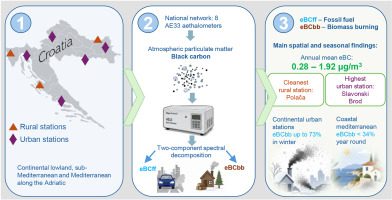
Understanding Black Carbon Pollution
Black carbon is a component of airborne particulate matter, mainly produced through incomplete combustion processes, including vehicle emissions and the burning of solid fuels. It has important implications for both human health and climate.
The researchers analysed four years of measurements (2022–2025) from eight monitoring stations across Croatia, covering urban and rural areas in different climatic regions.
The study examined the contributions of two major pollution sources: fossil fuel combustion and biomass burning.
Key Research Findings
The study revealed significant differences between continental and coastal regions:
- Continental cities: Biomass burning, particularly residential heating, was a major contributor to winter black carbon pollution.
- Coastal areas: Traffic emissions remained a more persistent source of black carbon, with weaker seasonal variation.
- Seasonal patterns: Winter biomass-burning contributions reached up to 73% at certain continental monitoring locations.
- Urban air quality: Traffic-related emissions remained an important source throughout the year.
Supporting Evidence-Based Air Quality Management
The findings highlight the need for region-specific approaches to air pollution management.
In continental urban areas, reducing emissions from residential heating could significantly improve winter air quality. In coastal cities, measures targeting traffic-related pollution may be particularly important.
This research contributes valuable environmental knowledge to the broader objectives of NextAIRE, supporting improved air quality monitoring, scientific collaboration and the development of more effective approaches to air pollution analysis.
Read the Full Publication
Title: Spatial and Seasonal Variability of Equivalent Black Carbon and Its Source Contributions Across Croatia
Authors: Darijo Brzoja, Valentino Petrić, Mario Lovrić, Nikolina Račić
Journal: Atmospheric Environment: X (Elsevier), Volume 31, Article 100496 (2026)
DOI: 10.1016/j.aeaoa.2026.100496
Full article: https://www.sciencedirect.com/science/article/pii/S2590162126000845