
Project NextAIRE [HORIZON-WIDERA] is pleased to announce a new peer-reviewed publication featuring key contributions from NextAIRE partners Mario Lovrić(INANTRO) and Tareq Hussein (INAR).
Article: DeepSIP: A Deep Learning Approach for Sensor Data Imputation and Time Series Forecasting
Journal: Springer | DOI: 10.1007/s44408-026-00145-y
Access: Open Access – Free to read and download
[READ FULL ARTICLE] https://link.springer.com/article/10.1007/s44408-026-00145-y
Abstract
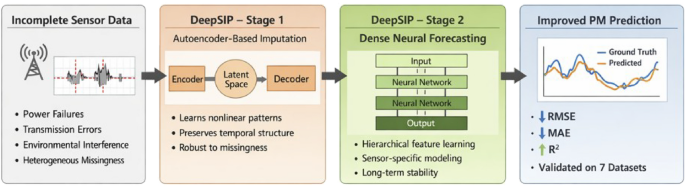
Large-scale datasets collected from sensor networks in domains such as industrial IoT, healthcare, transportation, and environmental monitoring often contain significant temporal and spatial gaps caused by sensor failures, communication losses, or maintenance outages. Such missing data can introduce bias, reduce reliability, and limit the performance of predictive models. To address this challenge, we propose DeepSIP (Deep Sensor Imputation and Prediction), a novel deep learning framework that unifies imputation and forecasting for multivariate time series data. DeepSIP employs a cluster-based training approach on fully observed sensor data to identify contextual and temporal patterns prior to imputation. Its autoencoder-based module learns latent representations from correlated sensor variables and contextual information (e.g., time and date) to reconstruct missing values. Subsequently, a deep predictive network with multiple fully connected layers is trained on the imputed datasets to model complex temporal and cross-sensor dependencies for accurate forecasting. Our experiments across various missingness scenarios demonstrate that DeepSIP consistently achieves the lowest reconstruction errors (MSE, MAE, RMSE) and the highest forecasting accuracy and scores compared to K-Nearest Neighbors (KNN), Multiple Imputation by Chained Equations (MICE), and Linear Interpolation. These results validate DeepSIP’s robustness and adaptability for sensor-driven applications, highlighting the importance of high-quality imputation in improving downstream predictive performance.
NextAIRE Authors:
- Mario Lovrić – Laboratory for Chemical and Biomedical Informatics, Center for Applied Bioanthropology, Zagreb, Croatia. Supported by EU-Commission Grant No. 101217310 – NextAIRE.
- Tareq Hussein – Environmental and Atmospheric Research Laboratory (EARL), University of Jordan; Institute for Atmospheric and Earth System Research (INAR), University of Helsinki, Finland. Supported by EU-Commission Grant No. 101217310 – NextAIRE.
Funding Acknowledgment:
This research was supported by NextAIRE (EU Horizon Europe Grant No. 101217310), ACCC Flagship (Research Council of Finland, project No. 272041), EMME-CARE (EU Horizon 2020 RI, project No. 856612), RI-URBANS (GA No. 101036245), Research Council of Finland (grant No. 362594), and the Deanship of Scientific Research of the University of Jordan. Open Access funding provided by University of Helsinki.