
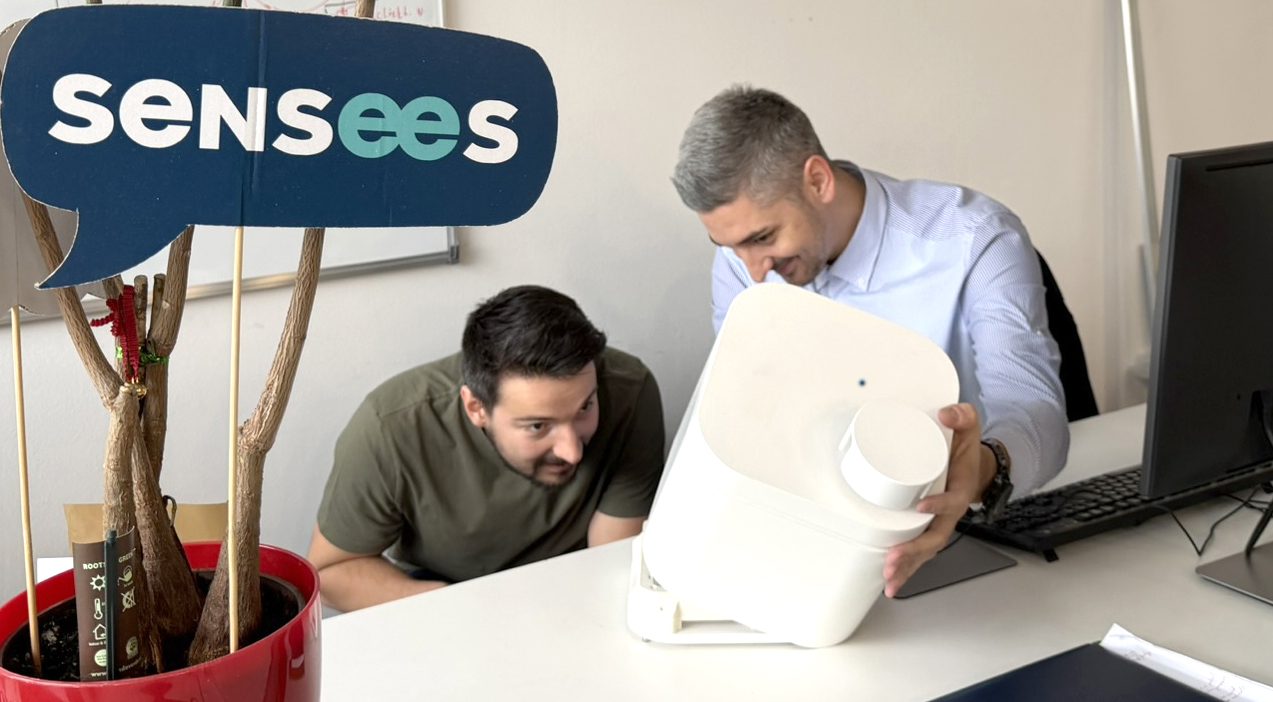
Amar Karadža (University of Sarajevo) with Zvonimir Anić, Project Lead at Smart Sense, reviewing a Smart Sense outdoor air quality monitoring station during the secondment.
We are pleased to announce the successful completion of the second secondment activity within the NextAIRE project — continuing the project’s commitment to mobility, collaboration, and knowledge exchange across Europe.
Building Skills Through International Collaboration
The second secondment involved Amar Karadža, Doctoral Researcher at the University of Sarajevo (UNSA), Faculty of Science, who visited SMART SENSE d.o.o. in Zagreb, Croatia, from 22 March to 5 April 2026.
The mobility was carried out under the subproject “Conduct co-location studies of low-cost sensors under inversion conditions typical for Sarajevo,” with the aim of improving knowledge of low-cost sensor technologies for air quality monitoring, strengthening practical skills in sensor performance evaluation, and exploring data-driven approaches to air quality forecasting relevant to Sarajevo and the Western Balkans.
Practical Work and Technical Experience
During the secondment, work was organised around two main strands: familiarisation with Smart Sense’s monitoring systems, and the development of a new comparative measurement approach.
Week 1 focused on onboarding and familiarisation with the Smart Sense outdoor air quality monitoring system, internal data management platforms, and the laboratory used for sensor calibration. Data structure was presented through a locally-hosted JupyterHub server, and access to datasets and software tools was provided by the host team, together with guidance on sensor operation and data interpretation. Examination of multiple datasets on NO₂ sensor stabilisation — across sensors deployed in different climate zones — pointed to an average stabilisation time of approximately two hours, information directly relevant to the planned comparative field study in Sarajevo. This first week also produced an initial methodological concept for combining low-cost sensor measurements with reagent-based integrated sampling and instrumental analysis, with particular attention to NO₂ as a key traffic-related pollutant.
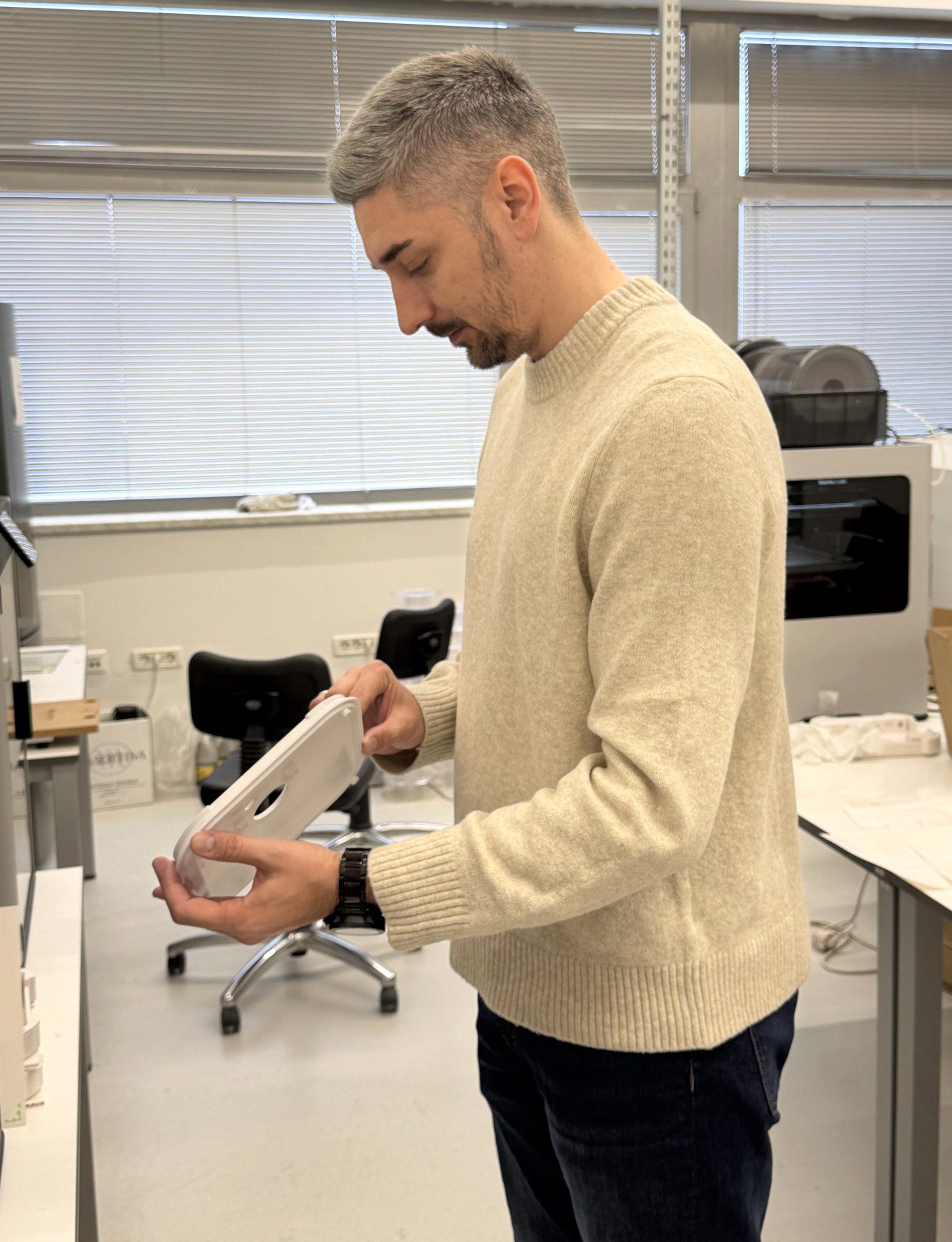 Technical work in the Smart Sense laboratory: evaluating hardware components for the ambient air sampling prototype.
Week 2 moved into practical development of this comparative sampling methodology. Work included drafting and refining a sampling setup for ambient air collection — combining a pump and calibrated flow meter with reagent-based gas absorption — and analysing technical considerations such as airflow stability, tubing configuration, sampling duration, and installation constraints. A preliminary hardware configuration was selected for the prototype, covering pump, flow meter, and a control and data acquisition platform suited to flow monitoring and local data display. This component evaluation provides the practical basis for assembling and testing the sampling prototype in the next phase of work.
From Research to Real Applications
The secondment offered direct insight into how low-cost sensor technology and IoT-based monitoring can be combined with complementary analytical methods to support more reliable air quality assessment — work with clear relevance for both environmental research and public health. The new reagent-based comparative method developed during the secondment will carry forward as a methodological contribution to the next stage of the research.
Strengthening European Networks
Secondments are a key pillar of NextAIRE, enabling researchers to gain practical experience, exchange expertise, and build long-term professional networks across sectors and countries. This second exchange reinforced the connection between the University of Sarajevo and Smart Sense — exactly the kind of cross-sector, cross-border network NextAIRE is designed to build.
The skills gained — from environmental sensor data analysis and statistical evaluation to interdisciplinary collaboration and technical reporting — will feed directly back into Amar’s doctoral research on atmospheric pollution, and into teaching activities at the Faculty of Science, University of Sarajevo, where practical examples on low-cost sensors, calibration, and data quality assessment will be integrated into courses on environmental chemistry and air quality.
“The secondment at Smart Sense provided valuable insight into practical applications of air quality sensor technologies and advanced data analysis approaches. Working directly with experienced engineers and researchers significantly contributed to my understanding of air quality monitoring challenges specific to Sarajevo and similar urban environments.” — Amar Karadža, University of Sarajevo
“It was a great pleasure to host Amar at Smart Sense and exchange knowledge and experiences through the NextAIRE collaboration. This kind of cooperation between academia and industry creates valuable opportunities for mutual learning, development of new ideas, and strengthening regional capacities in the field of air quality monitoring and environmental technologies.” — Zvonimir Anić, Project Lead at Smart Sense
This second successful exchange builds on the strong foundation set by the first NextAIRE secondment, confirming the value of mobility activities for both sending and host institutions.
We warmly thank Smart Sense d.o.o. for hosting the second secondment, and especially Zvonimir Anić for his valuable mentorship, guidance, and hospitality throughout the visit. We also thank all consortium partners who contributed to the successful implementation of this mobility activity.
We sincerely thank Amar Karadža for his valuable participation and contribution.
Stay tuned for more upcoming NextAIRE secondments, training activities, workshops, and project achievements.
Funded by the European Union (HORIZON-WIDERA-2024-TALENTS-03-01; Project number: 101217310). Views and opinions expressed are however those of the author(s) only and do not necessarily reflect those of the European Union or European Research Executive Agency. Neither the European Union nor the granting authority can be held responsible for them.